




Blog
Food for health from the hive


Bees produce far more than just honey. Their hives are the source of natural products that have long been valued for their nutritional value and abundance of biologically active substances. Honey, bee bread, pollen and royal jelly have been used in the daily diet for centuries, and today their properties are increasingly becoming the subject of scientific research.
Each bee product plays an important role within the hive itself. Honey provides the bees with energy, bee bread becomes the main source of protein, and royal jelly is a special food for the queen and young larvae. It is precisely this natural diversity that ensures that each product has its own unique composition, flavour and potential uses in the human diet.
In this article, you will learn how the most important bee products are made, how they differ from one another, and what benefits they offer to the body. We’ll also take a look at what makes honey, bee bread and royal jelly so special, and why they are still considered to be among the most valuable food products created by nature.
How is food for health born?
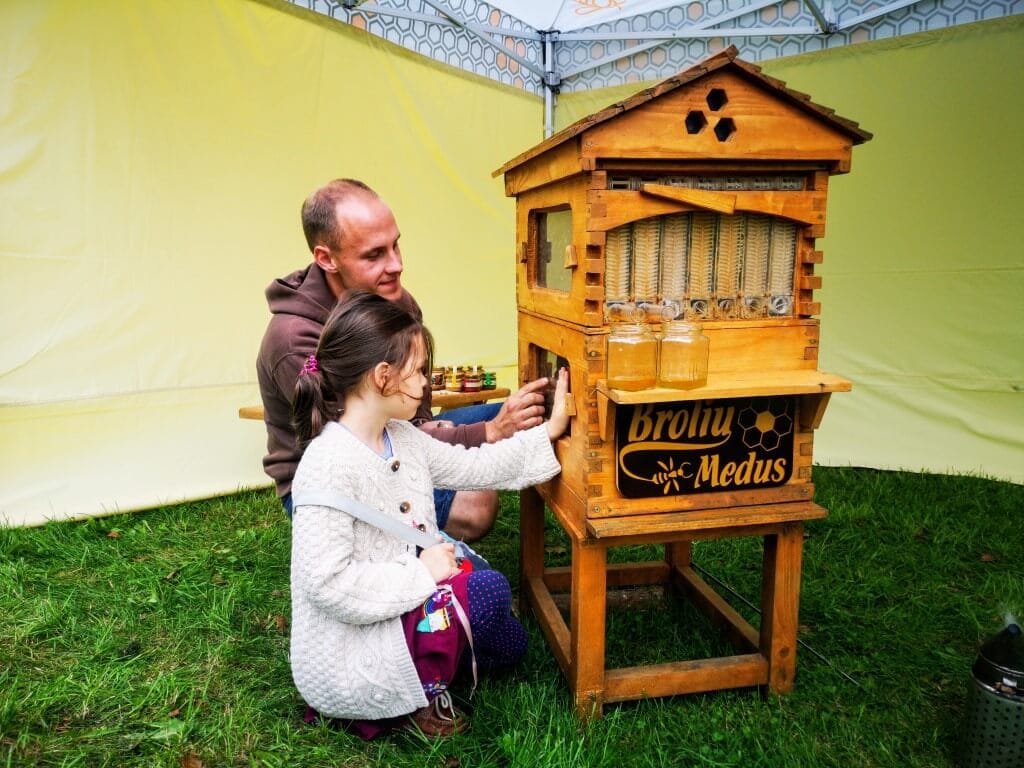
In our flow hive, you’ll not only see bees up close, but you’ll also get to taste the freshest honey.
Vacuum, vacuum, and vacuum again.
Did you know that bees are real preservation aces. In their six busiest weeks, they produce more mini-jars (honeycomb cells) than we can preserve cucumbers in our lifetime. Apparently, this is the answer to the question: why do we run out of cucumbers before the New Year, while they enjoy their food until the next cropping season?
Packing is one of the oldest preservation methods, and one that the bees themselves will probably invent. And if we disinfect or sterilise jars, boil them and heat them, all the bees need is one small layer of wax and “tadaam!”, the can is sealed. Tempted? Readers with weak nerves are advised not to try this at home: you will end up with both no cucumbers and no nerves.
Bees start storing up for winter long before we harvest our crops, when the last of the summer plants are flowering. It is very important for them to fill their stores as much as possible, because you never know what kind of winter you will have: whether spring will be early, or whether the slow-movers will be reluctant to creep through the fields; whether there will be a feast in the hive, or whether you will have to scavenge on your modest, dwindling savings, almost like we do on the days before the algae days… Most of all, flies love fermented and ripened products, or those that are freshly made by the bees. Although they are reluctant to divulge their recipes that have been handed down through the generations, we share with you what we have found out.
Aged honey instead of sugar
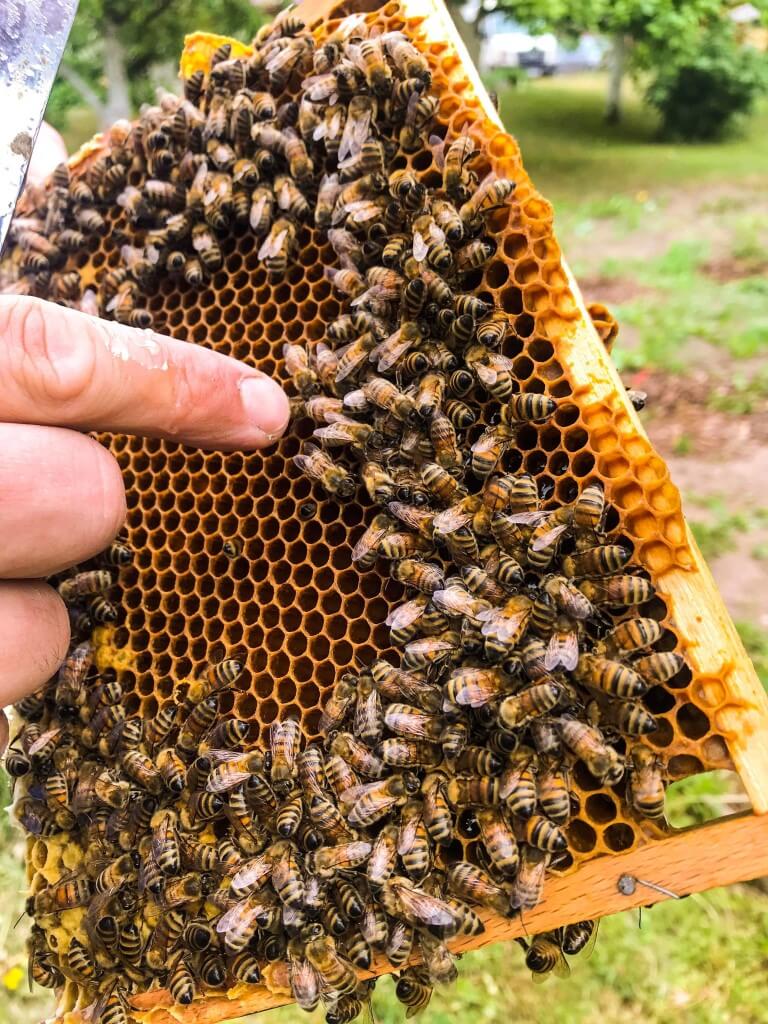
Fresh honey in combs that have not yet been harvested.
Honey – a natural sugar substitutewhich does not cause a sudden spike in blood sugar (so it can be used for diabetes), and, if honey is not heated, it also contains a wide range of vitamins and minerals, which is not the case with sugar.
You may say that the bees are spoiled, that they only eat honey that has been aged… The truth is that the honey that ends up on our table is also aged. Well, unless you order honey that is freshly harvested and not even ripened, which unfortunately is not very good for wintering. Bees know this and prepare honey for the winter with great care. The main ingredient in this bee preserve is plant nectar, which the bees pour into the honeycomb. Making honey is similar to making soup – how much and what kind of plants you add is what you get. But it’s much easier to spoil the soup… Once the honeycomb is full, the bees use their semi-automatic, electricity-free conditioner – their wings – to aerate the nectar until it reaches the right consistency. The hive’s chefs assess the nectar and, if they are satisfied with the result, the cells are sealed with a thin but tight wax cap. And no added E.
Matured honey differs from fresh honey in colour, consistency and nutritional value. This honey sets more quickly, has a creamy consistency and a distinctive flavour. Of course, this also depends on the plants from which the nectar is collected. Buckwheat honey is spicy and almost chocolatey, whilst linden honey is golden and delicate. Raspberry honey protects you from the bitter cold of autumn, and dandelion (spring) honey – from vitamin deficiency in spring. Every honey is special in its own way. The different types of honey are described in more detail in our blog post. You’ll also find the topic ‘The benefits of honey for the human body’, where we share scientists’ insights on honey.
Maturing honey, like fermentation, involves chemical processes that transform some substances into others that are more easily absorbed. Moreover, it is the aged honey that the Egyptians said has no expiry date and is an inexhaustible source of energy. And what more do you need when spending the cool days in the hive?
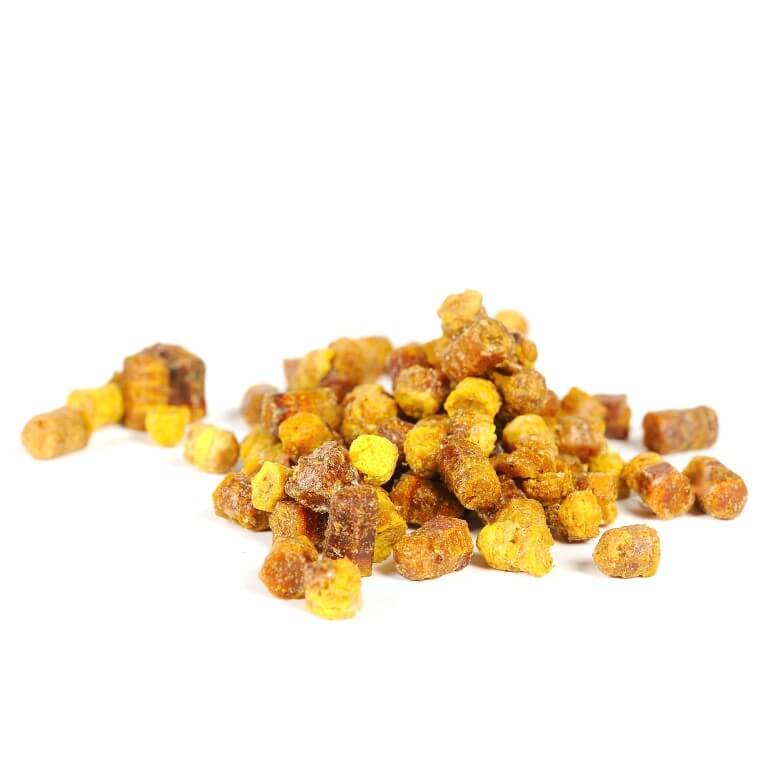
Dried bee bread
Sourdough bee bread – real health food
Bee bread is primarily a source of protein, And regular use can be expected not only to replenish vitamins and minerals, but also to have anti-inflammatory, antiseptic and regenerative effects on all the cells in the body.
Fermented products are said to be a very healthy choice, enriching your body with a variety of enzymes, minerals and other beneficial substances. Apparently, the bees have heard this saying and spread it throughout the hive, because ‘fermented’ pollen (the bees’ bread) in honey is their signature dish, which every hard-working bee knows how to make: from the tiny ones that have just hatched to the mature honey-gatherers. For those who haven’t tried it yet, we strongly urge you to give it a go – we’re confident you’ll be amazed by the range of flavours, as every little loaf is like a new, undiscovered world, with its own magical taste. And now we’re eager to reveal part of the bee bread recipe, passed down from generation to generation, in case – whether by design or by chance – you decide to ‘bake’ this ‘preserve’ at home.
So, if you want to make bee bread for the winter, the first thing you’ll need to do is to collect all kinds of pollen. Bees collect them on the hairs on the back of their legs. So, the easiest way is to run through a few kilometres of fields barefoot with a smart app that counts kilometres. Once you’ve clocked up at least fifteen, you can “fly” or “crawl” home (well, whatever you prefer). Congratulations, this is the easiest part of bread-making. When you get home, it is preferable to literally scrape all the pollen off your legs and put it in the honeycomb eyes. It is very important to press them well. Easy, right? Finally, the pollen is covered with honey, sealed with wax and left to ‘harden’ at a constant temperature. It is the fermentation process that gives bee bread its sweet and sour flavour, in a way similar to fresh rye bread.
Bee bread is the main non-perishable protein source in the hive. Just don’t think that they are “building muscle” in the hive in winter. Protein is essential for all processes in the body: we need enzymes, which are proteins, to digest bile; cells need building materials, which are mostly proteins, to grow; even the feeling of happiness depends on protein products – hormones. So, in the hive in winter, bees grow, digest and live surrounded by hormones of happiness.
And it’s delicious, bee bread has a very high content of valuable components. Taigi, bee bread is rich in vitamins, proteins and carbohydrates, natural amino acids and enzymes, essential oils and other beneficial substances, not only for the bees but also for us humans. Benefits of bee bread is not only proven by scientists, but is also a favourite in folk medicine. Although this bread will not make sandwiches, it is perfect for dessert or snacks.
Impressive royal jelly (apiilac) impact
Royal jelly is a very potent natural substance, so we recommend taking it in very small doses. It is easier to say what is not in royal jelly than what is, because even scientists have not yet fully investigated its composition. It is so rich in nutrients that royal jelly is considered one of the best natural products for helping the body recover more quickly after exhaustion or for replenishing the body’s nutrients during mental work or vigorous exercise.
Scientists are constantly researching this miracle queen food, but they cannot produce synthetic counterparts – even when tortured, bees do not share their recipes. All that has been found is a complex composition containing a wealth of vitamins, minerals, enzymes and other biologically active substances. However, given the right conditions, royal jelly does not have to be made – the flies will give it to us. Just remember that it will have to be stored in the fridge, like all fresh products, and not in the store room next to the jams.
Milking bees is no joke. But experienced beekeepers have mastered the art of, let’s call it, milking – so you don’t have to milk anything to get a taste of royal jelly. Bees don’t actually produce milk, but they do secrete a white liquid that looks like milk, which they use to bathe their young larvae and queen. This secretion was named royal jelly because of its purpose and its resemblance to milk. Worker bee larvae are only fed on royal jelly for the first few days of their lives, whereas the queen and adult larva feed exclusively on it throughout their lives. Royal jelly has gained recognition and interest since it was discovered that, although all bee larvae are the same, some larvae develop into queen bees when they are fed only royal jelly. Since then, royal jelly is considered miraculous and extremely valuable. It is rich in proteins, carbohydrates, minerals, essential amino acids, hormones and other biologically active substances. Due to its rich composition and strong effects, royal jelly should not be multiplied and, unlike other bee products, it should be used as a medicine rather than as food.
Unlike many of the products in the bees’ pantry, royal jelly is always fresh and freshly made. Thanks to their abundant reserves, bees are not only able to survive, but also to continuously produce royal jelly, which is the queen’s snack, main course and dessert. Royal jelly is also the larvae’s staple food, so it’s a must.
Bee products are excellent for your health – both physical and emotional. However, they are food, not medicine, so any benefits can only be realised through consistent, long-term consumption. And for those looking for a different way to enjoy the taste of honey, it’s worth trying honey-flavoured sweets, which are popular with both children and adults.
Stay healthy and happy!
[ux_bestseller_products products=”” columns=”4″ title=”Health products – straight from the hive”]