




Blog
Types of honey. What is the best honey?

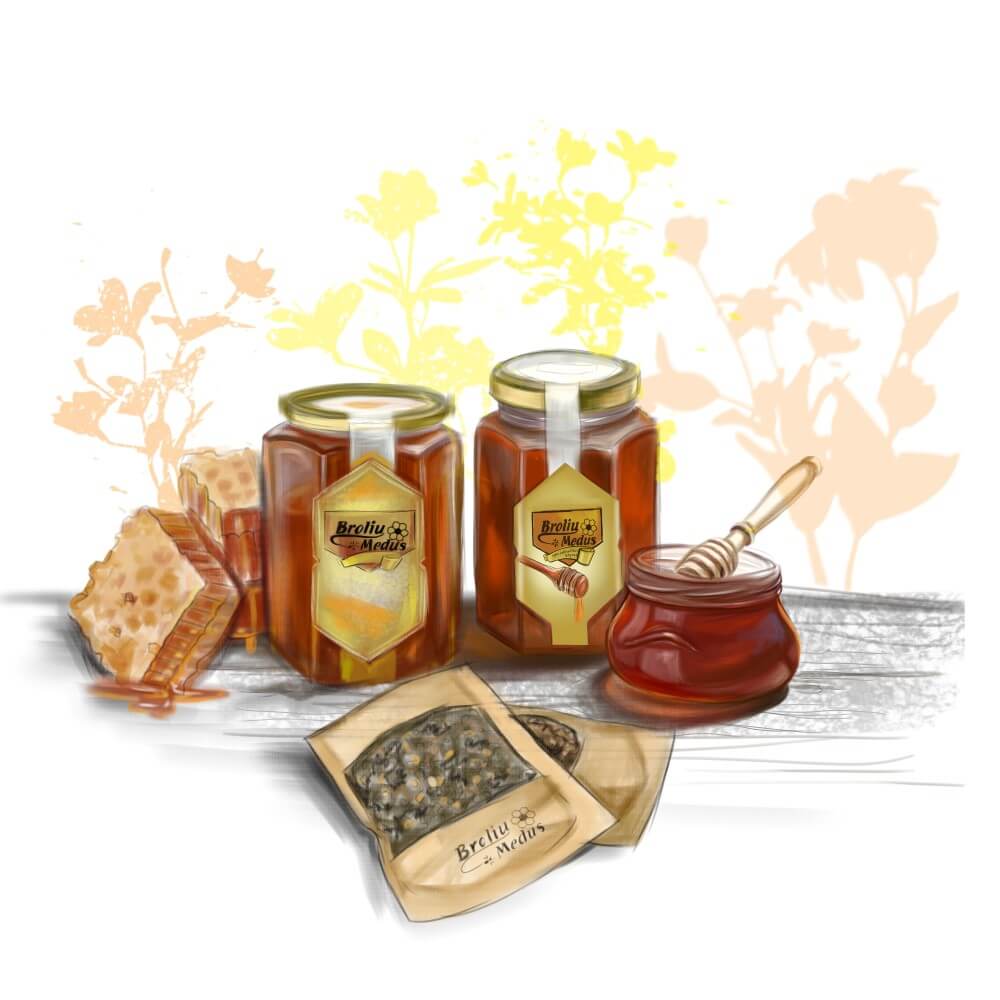
Not all genuine honey is the same – it varies not only in colour and taste, but also in its properties. Some honey is milder and lighter, whilst others are dark, full-bodied and rich in minerals and antioxidants. All this depends on the plants from which the bees collect their nectar.
We often hear the question: which honey is the best? The truth is, there is no single answer. Some types of honey are more highly valued during the cold and flu season, whilst others are prized for their higher antioxidant content or stronger effects on the body. Therefore, it is best to choose honey not only for its taste, but also according to what your body needs most at that particular time.
In this article, we will briefly discuss the most popular types of honey in Lithuania, how they differ and what their characteristics are.
The most valuable honey. How ichoose?
The value of genuine honey and its health-promoting properties depend largely on the characteristics of the plants from which the nectar is collected. For example, lime blossom honey is best for colds, whilst buckwheat honey soothes the central nervous system, and so on. The value of honey is usually determined by its antioxidant and mineral content, which can be easily assessed by looking at the honey – the darker it is, the richer it is.
In Lithuania, buckwheat and lime honey are considered to be among the most valuable. Buckwheat honey is a deep brown honey with a strong aftertaste, rich in antioxidants and iron. As the human body can absorb almost all the beneficial substances found in honey, it is highly recommended for treating anaemia and strengthening the nervous system. Lime honey, on the other hand, has a rather mild flavour, is light in colour and often has a creamy consistency. It is arguably the most popular honey in Lithuania, and its properties are also the best known: it has a calming effect, helps with colds and respiratory tract conditions, and also promotes sweating, so it should not be consumed in excess. Among other natural bee products, bee pitch (propolis) is increasingly mentioned and valued for its antibacterial and antiseptic properties.
Spring honey is among the most valuable. Bees produce it from the nectar of flowers in orchards and meadows. It becomes particularly valuable if dandelion nectar predominates in the spring honey. In that case, this honey becomes a powerful weapon in the fight against colds, as it has many antibacterial properties. Spring honey is considered one of the least allergenic types, which is why it is particularly recommended for children. And for those wishing to discover more interesting forms of bee products, natural honey gumdrops are attracting increasing attention, and are enjoyed by both children and adults. Honeydew honey also has strong anti-inflammatory properties. Honeydew is the plant sap produced when aphids ‘feed’. It is collected and used by bees in the same way as nectar. Honeydew honey is also dark in colour because it is rich in antioxidants as well as minerals. For this reason, it is classified as a high-potency honey and should not be consumed in moderation, especially by children.
There is no consensus on which honey is the most valuable. However, buckwheat, lime, spring and linden honeys are recognised as containing the widest variety of nutrients. However, alongside the various types of honey, bee pollen is also attracting increasing attention, valued for its rich content of nutrients and antioxidants. Genuine honey, collected at different times from different plants, varies in its properties; therefore, it is best to choose honey according to your needs and the properties you require most.
Taste and be healthy!
6 thoughts on “Types of honey. What is the best honey?”
Comments are closed.