



Blog
How to tell the difference between real and fake honey: tests, labels and reliable sources

How to distinguish between real and fake honey is a question that almost every conscious buyer asks today, as the market for fakes has become more sophisticated than it was a decade ago. According to the European Commission's coordinated From the Hives study, almost half of the honey samples imported from third countries are suspect in terms of compliance with the EU Honey Directive, so buyer vigilance has become a real shield against overpayment.
The problem is that many of the popular tips on the internet, such as the burn test or the drop on the thumb test, have no scientific basis and can mislead even the most careful consumer. Genuine assessment relies on several sources: a combination of several home tests, careful reading of the label and transparency of the supply chain.
We'll look at which home methods really make a difference, how to decipher origin labels such as „EU and non-EU honey blend”, what the phrase „100% pure honey” means, and why direct contact with the beekeeper remains the most reliable protection against fakes.
Simple home tests to assess the authenticity of honey
No single home test is 100% foolproof, but combining several can help identify the most common fakes. The more marks that match, the better the chance of assessing the authenticity of the honey without a laboratory.
The most popular tests used by buyers are water, iodine, paper, viscosity and spoon tests, as well as long-term monitoring of crystallisation. Each of these reveals only part of the truth, so a single result should not lead to a final decision.
It's worth looking critically. The beekeeping community and practitioners sharing in international forums acknowledge that many popular tests are myths: high-quality fakes pass them, while some genuine honeys fail. A more accurate approach is to look at the label, the origin and the relationship with the beekeeper himself, and to use home tests as a primary filter.
The water test - what does it really show?
The water test is simple: a teaspoonful of honey is gently dropped into a glass of cold water, and the honey is observed to see whether it sinks to the bottom in a compact clump or immediately begins to dissolve and cloud the water.
In practice, this test does not give a reliable answer. Genuine honey with a higher moisture content (e.g. early harvested or lime honey) may start to dissolve in water, while a quality fake with glucose-fructose syrup will remain compact just like natural honey.
It is therefore worth considering the water test as just one signal among several. Combine it with viscosity monitoring, a label and a reliable honey source to make the final decision.

Iodine test for starch detection
The iodine test is carried out by placing a drop of iodine solution on a small sample of honey diluted with warm water. If the mixture turns blue or dark purple, this indicates an admixture of starch or flour, a classic, ancient form of honey adulteration.
The reaction works because the iodine binds to the starch molecules to form the characteristic blue complex. The test reliably detects only this specific adulterant.
However, modern counterfeits with glucose-fructose or rice syrup do not react with iodine because they do not contain starch. The test should be considered as a primary filter: it helps to reject gross adulterations but does not protect against refined syrup adulterations.
Monitoring viscosity and crystallisation
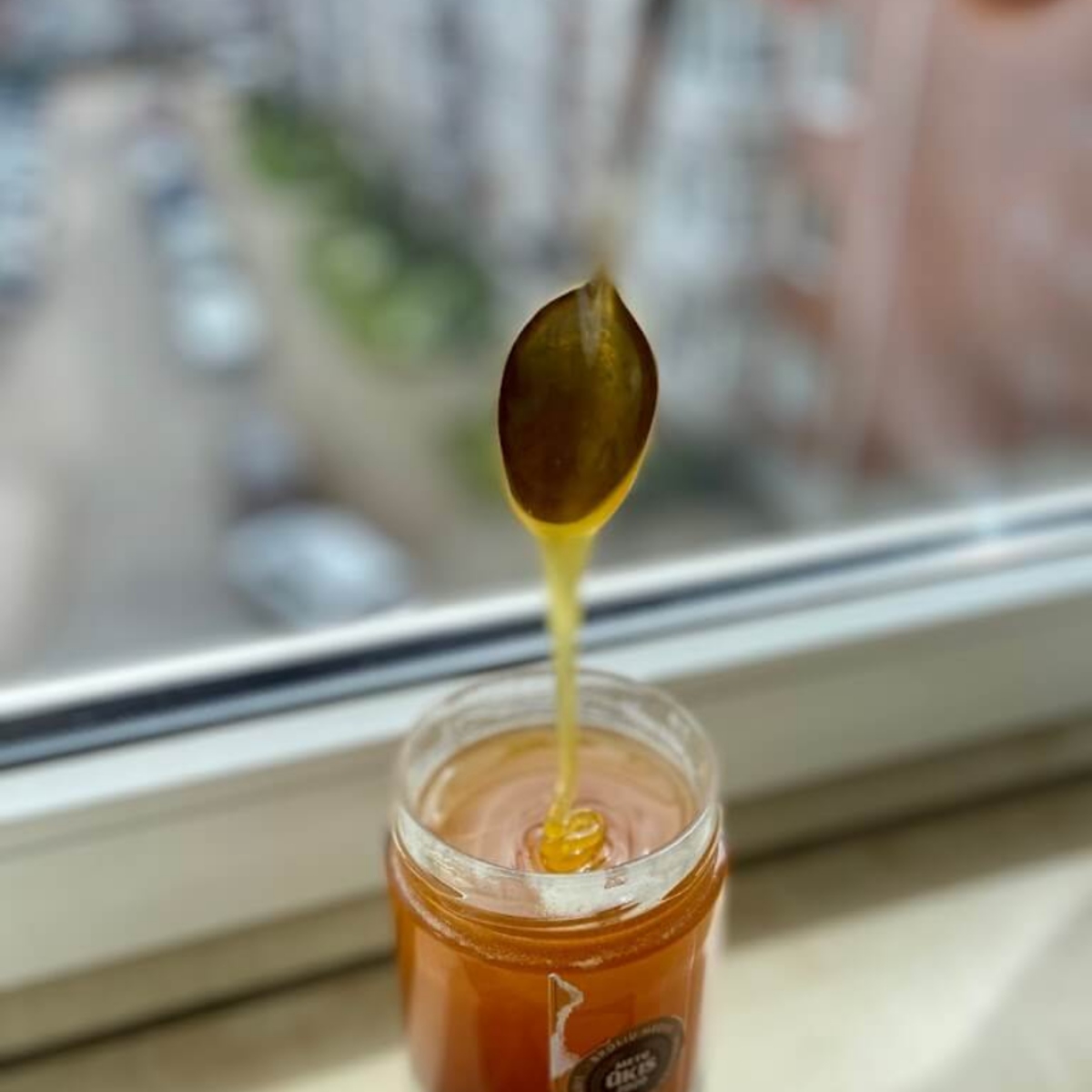
Real honey is viscous, flows slowly from the spoon and breaks off to form a thin thread rather than individual droplets. A runny, watery flow is often an indication of too much moisture or dilution with syrup.
Crystallisation is usually a good sign of certainty, not a defect. Glucose spontaneously turns into fine crystals, especially in cooler environments, so hardened or whitened honey is usually an indication of natural composition.
But there are exceptions. Acacia and honeydew Honey crystallises very slowly due to its high fructose content, sometimes remaining liquid for years, so clear acacia honey is not automatically suspect.
On the other hand, if lime, buckwheat or herbaceous plants the honey is still completely runny six months later, this is a suspicious sign. Such honey has probably been heated (which destroys the enzymes and increases the HMF content) or diluted with syrup in order to keep it looking attractive on the shelf.
How to read the honey label and what does it say about the quality?
The label is one of the most reliable clues for the shopper in the supermarket, revealing the origin, composition and length of the supply chain before the lid is even unscrewed. Careful reading of the label eliminates most of the most obvious risks.
The biggest „red flag“ is the phrase „EU and non-EU honey mix” or simply „honey blend”. This means that the honey in the jar comes from several countries, often including China, the world's most falsified country of origin. The longer the supply chain, the harder it is to trace what is actually inside.
The opposite signal is single source honey with a specific country, region or even apiary. A narrower source means a shorter chain and easier quality control. Lithuanian honey with a named beekeeper is the most reliable option on the local market.
The composition section should be as short as possible. Real honey contains Honey ONLY - no glucose-fructose syrup, sugar, colours, flavours or preservatives. Any additional ingredient means that the product is no longer pure honey according to the legal definition.
The „organic” or „organic” label indicates bee-keeping and environmental practices, not the absence of adulteration. The certificate is useful, but it does not guarantee that the honey has not been overheated or diluted.
Warning words on the label that are worth responding to:
- „Honey blend” or „blend of EU and non-EU honeys”
- No specific country or region of origin specified
- Syrup, glucose, fructose or sugar mentioned in the contents
- No year of collection or batch number
- Named colourings, flavourings or „honey flavour” additives
For more on the different types of honey and their properties, see the article what is the best honey.

Is honey 100% pure? How can the buyer check this?
Pure honey is honey that contains nothing but nectar or honeydew collected and ripened by bees. There are several different concepts circulating in the market that are worth distinguishing before assessing purity.
Natural and pure honey means a product without additives, raw - unheated above 40 °C and unfiltered, which preserves the enzymes and pollen. Heated honey becomes more fluid and does not crystallise for longer, but loses some of its biological activity. Mixed honey combines several sources and artificial often have no bee contact at all.
Counterfeiting takes several forms. The most common is dilution with glucose-fructose or rice syrup, which has a chemical profile similar to honey and is difficult to detect. Another technique is ultrafiltration, which removes the pollen, making it impossible to identify the geographical origin.
Professional laboratory indicators help to assess quality objectively. Number of diastasis indicates enzyme activity and decreases if the honey is heated or old. Hydroxymethylfurfural (HMF) works in reverse: its content increases with heating or prolonged storage. Moisture content is measured with a refractometer and in quality honey is usually below 18-20%.
The buyer can make use of these indicators even without a laboratory. Ask the beekeeper to show you the test report, ask for diastase and HMF values and check that the label gives a specific date of collection, not just the year of packaging. An honest beekeeper can easily provide these data.
However, it has to be admitted: high-end fakes, created according to the European Union's indicators for honey, can even meet laboratory parameters. As a result a source more important than paper - A beekeeper you know, whose hives you can see with your own eyes, offers more guarantees than any certificate on a supermarket shelf.
Buying from a trusted beekeeper is the surest way
Direct contact with the beekeeper is the surest way to ensure the authenticity of the honey, as trust grows through the relationship and not through random home tests. When you know the person, the location of the apiary and their working methods, the risk of adulteration is minimised.
Before you buy, ask the beekeeper a few key questions:
- Where the hive is located and its surroundings
- Is the honey local or mixed with imported honey
- In which year a particular honey was harvested
- How it is stored (temperature, containers, light)
- Laboratory tests (diastase, HMF, moisture)
An honest beekeeper will be specific and will not evade questions. Even better if you have the opportunity to visit the apiary in person. Many beekeepers give educational tours, allow you to see the hives and even watch the honeycombing process, so you can see for yourself how honey appears from ring to jar.
Supermarket honey is statistically more risky due to its long supply chain, mass mixing and imports from China and other countries where adulteration is more common. Reliable beekeepers can be found through the Lithuanian Beekeepers' Union or local beekeeping communities, which monitor the reputation of their members.
„Brolių medus follows this principle: a local apiary, open education for visitors, and a direct link with each customer so that they know who and how the contents of their jar were grown.
Frequently asked questions about real honey
Is honey that crystallises real?
Yes, crystallisation is usually a sign of certainty, not a defect. Glucose naturally turns into crystals over time, especially in cool places, so hardened honey is usually an indication that the product has not been overheated or industrially processed.
There are exceptions. Acacia and honeydew honey due to its high fructose content, it crystallises very slowly, sometimes remaining liquid for years. On the other hand, if regular lime or buckwheat honey is still completely liquid after a year, it may have been heated (which reduces enzyme activity) or diluted with syrup.
Does the phrase „EU and non-EU honey blend" on the label mean the honey is bad?
Not necessarily bad, but certainly risky. This wording indicates that the package is mixed with honey from several countries, often including China, which is a global supplier of fake honey.
The long supply chain makes quality control more difficult, as several intermediaries come between the beekeeper and the shelf. The most reliable choice is single origin honey with a specific country of origin, ideally Lithuania, where you can even trace back to a specific apiary.
Can you really identify fake honey with a water test?
To be fair - the water test is not a reliable stand-alone method. Some genuine honeys with higher moisture content do not pass it, while quality fakes with thick syrup can successfully sink to the bottom of the glass.
The water test is only worth using as one of several clues. A more reliable solution is to combine several clues: viscosity, crystallisation behaviour, label information and, above all, the reliability of the source.
How can fake honey harm your health?
Counterfeit honey usually contains glucose-fructose or rice syrup, which acts like a normal added sugar in the body: it raises blood glucose levels sharply, but does not contain the enzymes, antioxidants or micronutrients found in honey. The consumer receives calories without any nutritional added value.
Overheated honey has increased hydroxymethylfurfural (HMF) a quantity that is undesirable with long-term consumption and is considered an indicator of loss of freshness. The main harm is that the buyer pays the price for a therapeutic product and receives a simple sweetener with undeclared sugar.
If you want to make sure you get real, Lithuanian honey with all the natural enzymes and trace elements on your table, choose it directly from the beekeepers. We, twin brothers Ignas and Vilius, care for 315 bee colonies and pack each jar with love, so we know exactly which hive your honey came from. Get to know „Brothers“ honey" in species and choose the flavour that best suits your expectations.
And if you're curious to learn how real honey is made, we invite you to our apiary's education sessions, which have already been attended by more than 13 000 visitors. Once you've seen the process with your own eyes, you'll never ask yourself the question „how do you tell the difference between real honey” again.