



Blog
Benefits, properties and uses of bee bread


Not all bee products receive the same level of attention. Although honey has long been a staple in many households, bee bread remains a discovery even for those interested in natural nutrition or a healthier lifestyle.
And yet, the interest shown in this product by scientists and beekeepers alike continues to grow year on year. And with good reason. Bee bread is distinguished by its high biological value, rich nutritional composition and the fact that the body absorbs it more easily than ordinary pollen. Bee bread is truly an extraordinary product created by bees.
However, this also raises a number of questions. What are the actual benefits of bee bread? How should it be consumed? How much should you have each day? Is it suitable for children? And how does high-quality bee bread differ from poorly prepared bee bread?

What should everyone know about it?
We’ve prepared a comprehensive article that will show you:
- What bee bread is made of and how it is made
- What are the benefits of bee bread for the body
- How to use bee bread
- What is the price of bee bread
- What is the shelf life of bee bread
Enjoy your reading, and if you need any advice, we look forward to hearing from you by phone, text or email.
Briefly about bee bread
Composition of bee bread % Protein Fats Carbohydrates Vitamins and minerals pH | 23 % 3 % 24 – 35 % 3 % ~4,3 |
| Vitamins and minerals in various proportions | C, B1, B2, E, K, B7, B9, B3, Fe, Ca, P, K, Cu, Zn, Se, Mg. |
| Benefits of bee bread | Anti-inflammatory, antibacterial, anti-cancer. |
| Consumption of bee bread | A teaspoon a day is usually recommended. |
| Shelf life of dried bee bread | Unlimited |
How is bee bread made?
Bee bread is pollen that has been compressed and preserved (fermented) in honey. This bee product is called ‘bread’ because of its distinctive fermented flavour, reminiscent of sourdough bread. Furthermore, the small hexagonal pellets really do resemble miniature loaves of bread.
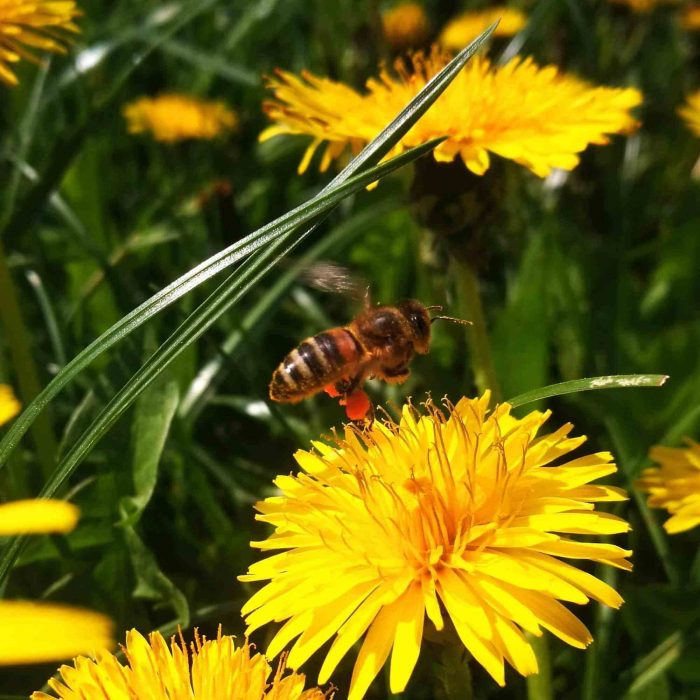
The bee collects pollen on its legs to make bee bread.
If you’ve ever seen a bee with a yellow ball of pollen on its legs, that was the clump of pollen she passed on to the other workers to place safely in the honeycomb cell when she got home. Once the honeycomb is filled with pollen, the bees fill it with honey and seal it. This is how the bees’ food is safely preserved for three weeks until it is ready to be eaten by both the bees and us.
If we eat pizzas, potatoes, meat, fruit, vegetables, and, and, and, and… then the bees don’t have much to choose from. Don’t think they are complaining – quite the opposite. They make superfood during the summer and feed on it all winter. Some of this is bee bread and some is honey. If this is how much bee bread benefits the bees, it can surely be called a superfood. Let’s think about it, if bees can survive all the winter harshness with these two products, they must be special. What’s more, bee bread is their only source of protein. Wouldn’t it be great if we didn’t have to go to the shops all winter to buy food, and only had to use bee bread to keep us going?
How is bee bread collected?
Beekeepers thresh bee bread just as they would any grain. As it is warm enough inside the hive, the comb containing the bee bread is still warm when it is first removed from the hive, and the bee bread is quite soft. To ensure we can remove it and separate it from the wax without breaking its integrity, we cool the comb and, using specialised equipment, simply shake the bee bread out into containers. It is then dried at a low temperature (as in the hive) and finally packaged before reaching your home.
What does bee bread consist of?
Bee bread, like all organic matter, is made up of carbohydrates, proteins, fats, minerals and vitamins. It contains mainly carbohydrates – glucose, fructose, sucrose and arabinose. In addition to carbohydrates, various amino acids make up approximately one fifth of its composition. Bee bread also contains around 40 saturated and unsaturated fatty acids, in important proportions, although not in large amounts. These include omega-3 and omega-6 fatty acids, which are essential for the human body because they cannot be produced and must be obtained from food. The special properties of bee bread are due to its polyphenolic flavanoids and polyphenolic acids.
Benefits of bee bread
More and more scientists, not only in Lithuania but also abroad, are seeking to uncover the benefits of bee bread. We’ll briefly share their findings. Bee bread stands out from pollen because it is easier to digest and absorb. What’s more, bee bread can be enjoyed by young and old alike, as these natural ‘vitamins’ are a big hit with children thanks to their great taste, whilst adults appreciate them for their invaluable properties. Those looking for more natural alternatives to everyday sweets also often choose gummy sweets made from high-quality ingredients.

The bread is matured and stored in honeycomb wells.
Regeneration-promoting effect
Thanks to its rich composition, bee bread can help in cases of avitaminosis or other vitamin deficiency diseases (anaemia or iron deficiency), injuries, bleeding, and recovery from various traumas. It has a strong regenerative effect on all cells of the body.
Antibacterial effect
Bee bread has an effect on microorganisms, even those that are resistant to antibiotics. This makes it a powerful natural antibiotic with no side effects. The enzymes and other organic compounds it contains inhibit the growth of microorganisms and help us fight a wide variety of infections. Bee pitch (propolis) has similar properties and has long been valued for its antibacterial qualities and potential beneficial effects on the body. Thus, the benefits of bee bread and the support it provides to our body’s defences are immense and highly significant, particularly during the colder months.
Antioxidant effect
Scientists suggest that bee bread may have beneficial properties in combating the effects of free radicals and in prevention, thanks to its antioxidant properties. It also has a positive effect on the body’s microflora and helps recovery from antibiotic treatment. Its inclusion in the diet can help to stimulate and activate immunity, as its various constituents have a positive effect on the production and synthesis of blood components.
Studies show that bee bread has a positive effect on blood glucose and lipid levels, helping to prevent chronic cardiovascular disease. How to consume bee bread to maximise its beneficial antioxidant effects has not been fully established.
Central nervous system excitatory effect
Bee bread is recommended for people with mental work or high stress levels, as it not only helps with physical recovery but also has stress-reducing properties. Bee bread also promotes regeneration of the nervous system and improves concentration and memory. Thus, regular consumption of bee bread promotes the regenerative properties of the central nervous system and improves all aspects of mental performance.
Anticancer effect
Scientists have found that bee bread is special because it has a negative (toxic) effect on cancer cells, while it even has a positive effect on cells in our body. It is not yet known exactly why these phenomena are observed, but as the researchers continue their discoveries, more answers should soon be forthcoming.
How to use bee bread?
How much to take?
As it is a food and not a medicine, the use and dosage of bee bread is not officially defined. Apitherapists recommend that adults consume a teaspoon or a teaspoon and a half (~20 g) daily. Children under 3 years of age should be given bee bread with caution due to possible allergic reactions (to pollen, honey). Thereafter, give as many grains as the child is old.

Ignas, a beekeeper, recommends eating bee bread in the first half of the day.
Is there a time when it is most effective to eat bee bread?
Definitely not in the evening. As it has energising properties, it is best taken in the morning or before lunch.
How to consume bee bread for maximum absorption?
Bee bread is more easily absorbed than pollen. The finer it is ground, the better it is absorbed; therefore, we recommend dissolving a spoonful of bee bread in warm water, adding a teaspoon of honey, and drinking it. If you ever fancy eating bee bread rather than drinking it, chew it as thoroughly as possible and slowly, letting it dissolve in your mouth before swallowing. Some of the carbohydrates will dissolve in your mouth, giving you not only a pleasant taste but also a burst of energy. So, you could try it as an alternative to coffee.
Like any natural product, the benefits of bee bread are not instantaneous. Only consistent use can produce the positive results we wrote about earlier. If you want to recover more quickly from illness or injury, you can take double the recommended amount of bee bread (~40 g) for several weeks. It is important to remember that it is almost impossible to overdose on bee bread, but eating it by the handful will not give a better result, as our body will not be able to absorb and store all the beneficial substances and a large part of it will simply be eliminated from our body. Therefore, moderate but consistent consumption of bee bread, with occasional breaks of a month or more, is essential for the best effect.
What is the optimum price for bee bread?
The price of bee bread is determined not only by market trends, but also by its origin, its environmental friendliness and other aspects. Since its characteristics are strongly influenced by the plants from which it is harvested and the appropriate drying temperature, not all bee bread sold is the same. Bread dried at high temperatures loses some of its nutritional properties. Only the beekeeper from whom you buy it can tell you where it was collected and how it was stored and dried.
Before it became popular, nearly a decade ago, the price of dried bee bread was just around 50 LT per kg. Now, year on year, due to its growing popularity, television programmes and widespread public awareness, the price of bee bread is rising. A couple of years ago, it cost around €30 per kg. The price of dried bee bread in 2021, partly due to the pandemic, has already reached around €60 per kg. You can find the price of our bee bread in our online shop.
Shelf life and storage of bee bread
Beekeepers dry bee bread so that it can be stored almost indefinitely. Dried bee bread has a shelf life of several years. Provided, of course, that you can stand it without eating it. Like all foods, it should be stored at room temperature.
For us, the best tasting is the undried bee bread. The latter should be kept in the fridge when used and in the freezer when not. This keeps it fresh and soft.
Our most popular bee products:


Bee pollen
Price range: €2.20 through €6.80
Bee bread
Price range: €2.80 through €16.35
The scientific sources we have used in this article include:
- Mărgăoan R, Stranț M, Varadi A, et al. Bee Collected Pollen and Bee Bread: Bioactive Constituents and Health Benefits. Antioxidants (Basel). 2019;8(12):568. Published 2019 Nov 20. doi:10.3390/antiox8120568
- Urcan, Adriana & MARGHITAS, Liviu & Dezmirean, Daniel & Bobis, Otilia & BONTA, Victorita & Mureşan, Carmen & Mărgăoan, Rodica. (2017). Chemical Composition and Biological Activities of Beebread – Review. Bulletin of University of Agricultural Sciences and Veterinary Medicine Cluj-Napoca. Animal Science and Biotechnologies. 74. 6. 10.15835/buasvmcn-asb:12646.
22 thoughts on “Benefits, properties and uses of bee bread”
Leave a Reply
You must be logged in to post a comment.
Great.I will have to buy it.
Tikimės, kad tiks ir patiks 😉
Great article. It’s great that you’re relying on scientific research.
Can I eat brioche bread if I have stage 2 diabetes?
Dalia, tikrai galima 🙂 endokrinologai, diabetikams dažnai rekomenduoja ir pataria vartoti bičių produktus žiedadulkes ar bičių duonelę.
Start with bee bread, take in the first half of the day, in small amounts and monitor the body
Can it be taken with a blood clot? Thank you
Tikrai galite vartoti 🙂 jokio pašalinio poveikio jaustis neturėtų
Can I eat brioche bread if I am allergic to pollen? Thank you
Svetlana, tikrai pamėginkite, tik pradėkite nuo labai mažų kiekių ir stebėkite kaip reaguoja Jūsų organizmas 🙂
Bee pollen contains far fewer allergens than pollen.
Can you eat honey? No allergies?
Do you ship abroad?
Fausta, žinoma! Mūsų produkcija keliauja po visą pasaulį 🙂
Tikrai galite vartoti drąsiai 🙂
Which is better for children who are often ill – bee bread or propolis? What is the difference between them?
Bičių propolio vaikams neduokite 🙂
Give children bee bread in the morning, as many years as there are grains. And take the bread for 5 to 6 weeks.
Then take a month break or change from bee bread to bee pollen and repeat the 5 to 6 week course
Can I eat biti bread during pregnancy?
Vilma, jeigu tai yra neštumo pradžia vartokite drąsiai bičių duonelę. Bet jeigu tai paskutiniai neštumo mėnesiai, geriau nevartokite 🙂
Can I use bee bread if my body stores iron?
Zita, dėl šio klausimo pasitarkite su savo šeimos daktaru 🙂
Good morning,
I would like to ask – 1) when taking royal jelly, is it possible to take bee bread or pollen? 2) For blood restoration, which honey is better – buckwheat or heather ?
Thank you for your reply. Yours sincerely – Ruth.
Hello,
Vartojant bičių pienelį, tikrai galite vartoti arba žiedadulkes arba bičių duonelę. Mes Jums rekomenduojame rinktis grikių medų 🙂