
Blog
Sustainable business: do bees really belong on the roofs of skyscrapers?


Aviliai ant biurų pastatų stogų atrodo kaip idealus tvaraus verslo simbolis. Jie gerai atrodo nuotraukose, patraukia darbuotojų ir klientų dėmesį, o įmonei leidžia kalbėti apie biologinę įvairovę, ekologiją ir atsakomybę aplinkai. Tačiau graži idėja dar nebūtinai reiškia, kad ji naudinga pačioms bitėms.
Miesto bitininkystė gali prisidėti prie augalų apdulkinimo ir paskatinti daugiau žmonių domėtis gamta. Vis dėlto, renkantis vietą aviliams, svarbu įvertinti ne tik komunikacinę naudą, bet ir oro taršą, karštį, vėją, maisto šaltinius bei galimybę bitininkui saugiai prižiūrėti šeimas.
Šiame straipsnyje aptariame, kada bičių laikymas mieste iš tiesų gali būti tvarus sprendimas, o kada aviliai ant stogo tampa tik patrauklia verslo įvaizdžio detale.
Miesto bitininkystė – mada ar tvarus sprendimas?
We believe that every step, even the smallest one, to create a sustainable environment contributes to the preservation of nature and, most importantly, engages those around us. But the vision of sustainability should not become a fashion that destroys natural processes. In London, Paris, New York, Berlin and other big cities, beehives have long been put on rooftops. Lithuanian entrepreneurs are slowly embracing the idea. Recently, four bee colonies - around 320,000 bees - were also placed on two business centres in Vilnius.
"Brolių medus has received several offers to place its bees on the roofs of multi-storey buildings in the capital, but it is the duty of every responsible beekeeper to first assess whether the proposed location for the hives is really suitable for the bees' natural habitat and the honey they produce. In order to ensure that bees can live a full life in the city, it is necessary to provide the right conditions and infrastructure for this. The site for the hives must recreate the natural habitat of bees. Otherwise, urban beekeeping in the city may resemble the sad sight of live fish aquariums in supermarkets that have finally disappeared.
 Negalima paneigti fakto, kad avilių įkūrimas urbanistinėje aplinkoje yra naudingas miestams ir jų gyventojams. Bitės, apdulkindamos augalus, prisideda prie miesto žalumos. Dėl to išsiskiria daugiau deguonies, oras tampa švaresnis. Rinkdamos nektarą jos taip pat renka pollen, kurios yra vienas svarbiausių bičių šeimos maisto šaltinių. Dėl Honey The quality could also be disputed. However, exposure to city dust, air-conditioning on buildings, car exhaust and other harmful environmental factors can have a huge impact on the life span of bees - cutting it in half.
We are not saying that urban beekeeping is mission impossible. On the contrary, it is a very welcome step towards sustainable business. We would just like to reiterate that it is important to provide the right conditions for this. If the location for beehives on the rooftops of buildings in the city centre is not the most suitable, the outskirts of the city may be ideal. An inspiring example is "Biržai bread", which has placed our hives on the edge of the city: in a spacious solar farm area, next to a sprawling forest.
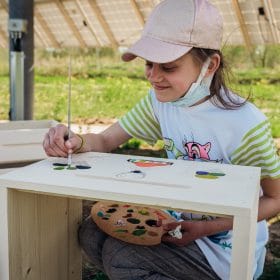
The 15 beehives located in Biržai region were impressively decorated by the students of the Biržai Art School. The colourful, atmospheric works of art were inhabited by the "Brothers' Honey" bees. In the future, the honey brought by the workers will be used by the bakers of Biržai Bread for their products. It is good when the development values of two different businesses coincide - it is a great opportunity to pursue more sustainable goals that contribute to a more sustainable society. A happy environment - happy bees - happy Honey – laimingi mes visi! Norintiems paragauti medaus kuo natūralesne forma verta išbandyti guminukus and medaus korį, kuriame medus išlieka bičių sukurtose vaško akutėse.